
When you talk about ERP software today, there is a good chance that the name Odoo comes up. The platform is used worldwide by millions of companies and supports almost all business processes: from CRM and sales to accounting, inventory management, HR, production, and e-commerce.
But did you know that Odoo started as a small student project in French-speaking Belgium?
In this blog, we will take you through nearly 25 years of Odoo history.
2005 – The Origin of TinyERP
Fabien Pinckaers developed the predecessor of Odoo, TinyERP, during his studies at UCLouvain. He found and still finds that existing ERP systems are far too expensive and complicated. His ambition was and is clear:
To develop a complete ERP system that is accessible and affordable for every company. And where the users are central: they should be happy using the software!
This resulted in TinyERP, a fully open-source ERP solution. It was released under a GPL (General Public License). This allowed everyone to download, use, and extend TinyERP for free.


The first functionalities consisted of software to automate core processes so that an SME could work with one system:
- Sales
- Purchasing
- Inventory Management
- Production
- Accounting
- CRM
- Marketing
At that time, it was particularly extensive.
2008 – TinyERP becomes OpenERP
As the software became more popular, the name TinyERP proved no longer suitable.
The package was by now anything but "tiny".
Therefore, the name was changed to OpenERP. The new name emphasized two important features:
- ERP software
- Open source
OpenERP grew rapidly. More and more companies started using it, and the international community also began actively developing modules.
2009–2013 – International breakthrough
In the following years, several major releases appeared. The software received a more modern architecture and became more attractive to larger organizations. The user interface was completely revamped with Ajax technology, making OpenERP much faster and more user-friendly.
2014 – OpenERP becomes Odoo
In May 2014 the name changed again. From version 8 the software is officially called Odoo.
Why?
Because the platform had by now become much more than just ERP software.
Completely new applications became available such as:
- Website Builder
- Webshop
- Point of Sale
- Events
- Helpdesk
The name OpenERP simply no longer covered the scope.
With the introduction of Odoo, a complete business platform emerged where all business processes come together.
.
2015 – Odoo Community én Odoo Enterprise
A significant milestone followed in 2015 with the introduction of Odoo 9. Until that moment, Odoo was completely open source. From Odoo 9 onwards, the platform was split into two editions. :
A. Odoo Community (OC)
The Community Edition remained fully open source and freely available. This version includes the basic functionalities for, among others:
- CRM
- Sales
- Purchasing
- Inventory
- Production
- Projects
Everyone can view, modify, and extend the source code.
B. Odoo Enterprise (OE)
Additionally, Odoo introduced the paid Odoo Enterprise Edition. This Odoo version is developed solely by Odoo S.A.'s own programmers. This therefore provides all the assurance that other standard software also offers.
This includes extra functionalities, such as:
- Advanced accounting
- Studio (customize screens yourself)
- Document management
- Digital signing
- CSRD
- Multi company
- Spreadsheet
- IoT, OCR
- Extensive mobile apps
- Extra AI functionalities
Enterprise is provided on a subscription basis per user. This version advises, implements, and supports dooIT as an Odoo Gold partner.
Odoo Enterprise version annual new version
Since 2014, Odoo S.A. releases a new major version every fall.
| Year | Version |
|---|---|
| 2014 | Odoo 8 |
| 2015 | Odoo 9 |
| 2016 | Odoo 10 |
| 2017 | Odoo 11 |
| 2018 | Odoo 12 |
| 2019 | Odoo 13 |
| 2020 | Odoo 14 |
| 2021 | Odoo 15 |
| 2022 | Odoo 16 |
| 2023 | Odoo 17 |
| 2024 | Odoo 18 |
| 2025 | Odoo 19 |
2026 | Odoo 20 |
Each new version contains many hundreds of improvements, new features, new apps, and optimizations. It is notable that Odoo SA in its development ''only looks forward (future) and never backward (taking existing features into account)''.
This makes dooIT emphasize to users the importance of truly, thoroughly, and intensively testing when migrating to a new Odoo version.
From ERP to complete business platform
Where Odoo used to be mainly an ERP system, it is now a complete business platform. There are now more than 80 official apps available, including :
- CRM
- Accounting
- Sales
- Purchasing
- Inventory
- Production
- Planning
- HR
- Marketing Automation
- Website Builder
- eCommerce
- Helpdesk
- Field Service
- Rental
- Document management
- AI tools
And all those 80 apps work fully integrated together. And all those Odoo apps are supported by dooIT .... except for one: the Payroll app from Odoo. dooIT has an API connection with various Dutch payroll systems (e.g., Nmbrs) that maximally supports the Dutch market (UWV, CAOs, Branches, LB connections, etc.)
Odoo in 2026
Almost 25 years ago, that first version of Odoo (tinyERP) has grown into a globally used platform with impressive figures:
- Meer dan 8.000 medewerkers
- More than 28 million Odoo users (OC and OE).
Tens of thousands of implementation partners and developers
- dooIT is among the Top 20 worldwide.
- Active in almost every country in the world
- 17 offices worldwide (see the image below for locations)
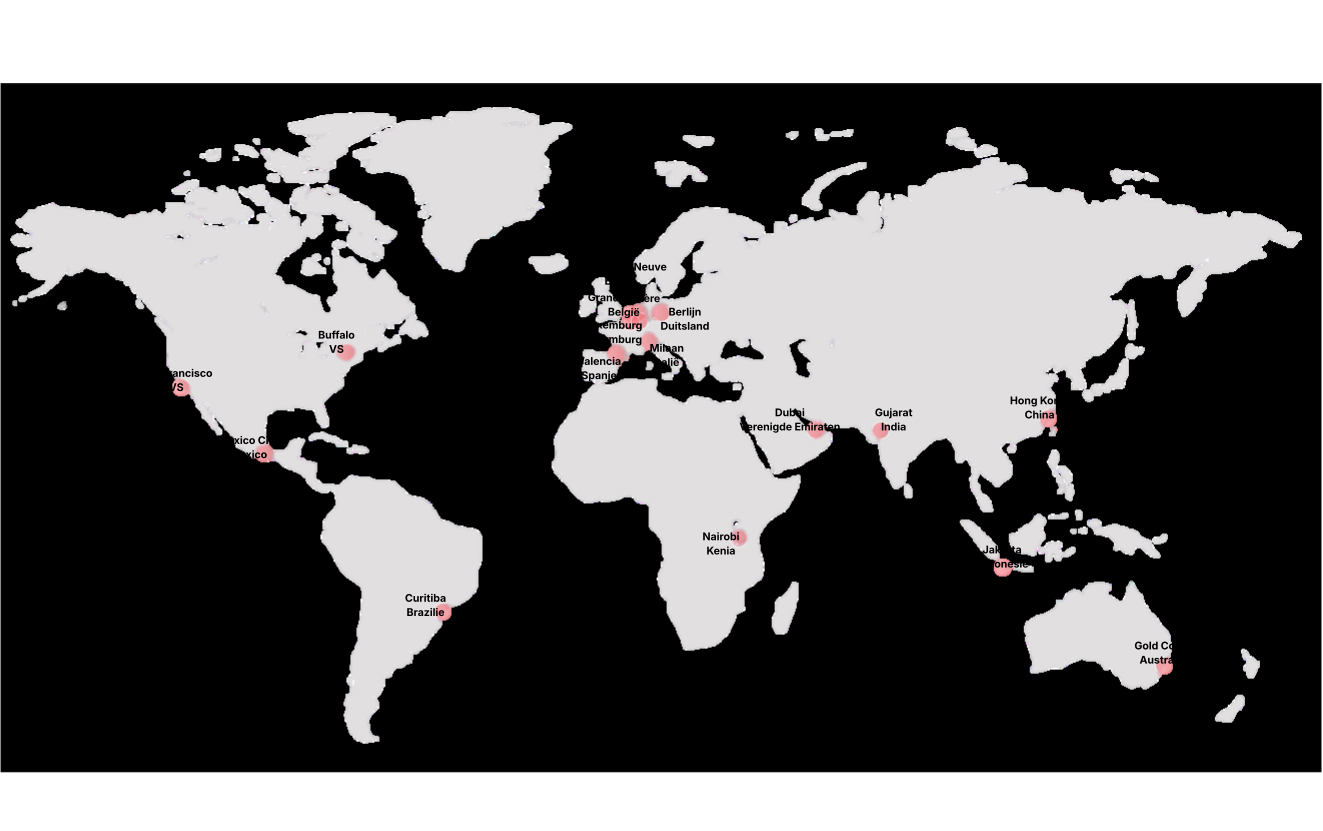
What once started as a Belgian student project has grown into one of the fastest-growing ERP platforms in the world.
The future of Odoo
Development is not standing still. In recent years, the focus has increasingly been on:
- Artificial intelligence (AI)
- Further automation
- Less customization
- Ease of use
- Integration of all business processes
By doing so, Odoo remains true to the original mission of Fabien Pinckaers: making business software accessible to every company, regardless of size. .
Conclusion
From TinyERP to OpenERP and finally Odoo: the history of Odoo shows how an ambitious Belgian open-source project grew into a global software platform over twenty years. The combination of open source, annual innovation, an active community, and a powerful Enterprise edition makes Odoo one of the most complete ERP solutions on the market today.